Addition of Rashi
Addition of rashis is done in several situations in Indian astrology. This basic mathematical operation needs to be studied and remembered in order to be ready for further computations in this science.
Addition of Rashis
All the planets move from one rashi to another in order along the eliptical orbit. Assume that the Sun is located at Tula, 21:13:14 (that is, in Libra sign at 21 degrees, 13 arc-minutes and 14 arc-seconds) today. Suppose you wish to find out where the Sun is located after 30 days, you can easily do so by adding 30 degrees to the longitude specified above. This is one of the use cases for addition of rashis. There are other areas in Indian astrology which uses this concept.
We will now discuss the procedure for addition.
We always start with the smallest unit (vikala) and move on to the biggest unit (rashi). Let us see with an example how 2 Rashis are added.
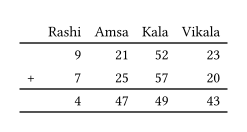
We start with vikala. Add $23+20$ to get 42. Kala - $52+57=109$, which is not possible since maximum of kalas is 60. Reduce 60 to get 49. 1 amsa = 60 kalas. This 1 amsa is carried over to the column on the left. $1+21+25= 47$. Calculate rashi total. We are getting $9+7=16$. The maximum rashi is 12. Reduce 12 to get 4.
Remember, the planets move from Aries to Pisces. This completes 1 round. They then start their second round. When we say rashi is more then 12, it implies that 1 round is complete and the planet has started the next round.
This being an important and highly used concept in Indian astrology, it is our suggestion that you should practice addition sums. Take any two planets' longitudes on any given date, time and place, and add. This will help in the long run.